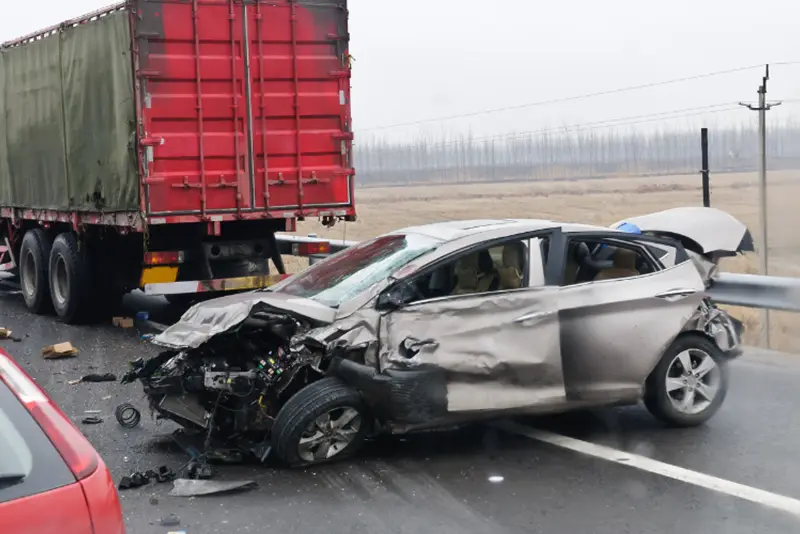
It happens in seconds. One car brakes hard. Another swerves. A third doesn’t see it coming until it’s too late. Metal hits metal, a domino effect that leaves you completely lost about what just happened.
Emergency lights flash around you. Police are interviewing other drivers. Your insurance company will call soon. But here’s what worries you most: who’s actually at fault?
In a California multi-vehicle freeway accident, liability isn’t always obvious. The driver who started the chain reaction isn’t automatically responsible for everyone’s damage. The car that hit you directly might not even be the main at-fault party. California’s rules around joint liability and negligence in freeway pileups are complicated, and insurance companies know how to use that confusion against you.
Understanding how California courts actually determine fault in multi-car accidents protects your settlement. Let’s break down the process so you know what you’re up against.
1. Who Is at Fault in a Chain Reaction Crash?
The obvious answer is usually wrong. You’d think the first driver to cause the accident takes all the blame. California law doesn’t see it that way.
Liability comes down to who was negligent and whose negligence caused your specific injury. That’s the legal standard. Multiple drivers can be at fault for the same accident. One might be 50% responsible, another 30%. A third driver might only be 10% liable but still owe you damages.
Let’s put it into perspective: Driver A brakes hard for debris in the road. Driver B doesn’t catch the brake lights in time and rear-ends Driver A. Driver C wasn’t paying attention and plows into Driver B. You’re Driver D, and Driver C’s impact pushes you into the middle.
So who caused your injury? Technically, Driver C hit you. But did Driver A’s hard braking set everything in motion? Possibly. Did Driver B’s failure to keep a safe following distance make things worse? Absolutely. In California, all three drivers could share liability for your damages. The percentages depend on how much each person’s negligence contributed to your specific harm.
That’s where things get messy. Every insurance company argues that its driver carries the least responsibility. They’ll say the car behind their client was following too close. They’ll claim the lead driver created an unavoidable hazard. Everyone points fingers, and you’re stuck in the middle.
2. How Does California’s Pure Comparative Negligence Rule Shape Multi-Vehicle Liability?
California follows pure comparative negligence. Simple idea: you can recover damages even if you’re partly at fault. Your payout gets reduced by your share of responsibility, nothing more.
If you’re 20% at fault on a $100,000 claim, you recover $80,000. Even if you’re 80% at fault, you still recover $20,000. Most other states cut you off at 50%. California doesn’t.
In a multi-vehicle accident, this gets complicated fast. Most of the time, no single driver is pinned as fully responsible. A driver who’s texting might be 70% at fault, but if the car in front stops without warning, that driver is at fault too. Every insurer argues percentages because the more fault they shift onto others, the less their client pays. Those arguments can drag on for months.
3. What Evidence Actually Proves Negligence in Freeway Pileups?
Proving negligence in a multi-car pileup means showing four things: duty, breach, causation, and damages.
- Duty is simple. Every driver owes every other driver a duty to drive safely.
- Breach is when that duty fails. Maybe the other driver was texting, speeding, or merging without looking.
- Causation is where multi-car cases get tricky. If Driver A’s texting starts the chain reaction, but Driver C’s car is what hits you, was Driver A’s texting the cause? Courts say yes, if the crash hadn’t happened without that initial breach.
- Damages are proven with medical bills, lost wages, and medical treatment records.
The evidence that actually matters includes police reports, witness statements, traffic camera footage, cell phone records, skid mark analysis, and vehicle damage patterns. Each one tells part of the story.
Insurance adjusters will cherry-pick whatever supports their client. They’ll say you were following too closely, that you were distracted, that the car ahead created an unavoidable hazard. Strong evidence shuts those arguments down before they gain traction.
NHTSA’s 2024 Traffic Safety Facts talks about distraction-related crashes across the United States using police-reported data from the Fatality Analysis Reporting System (FARS) and the Crash Report Sampling System (CRSS).
Key findings:
- In 2024, distracted drivers were involved in crashes that killed 3,208 people.
- Distraction is involved in an estimated 8% of fatal crashes, 13% of injury crashes, and 12% of all police-reported crashes.
In a multi-car accident, proving that a driver was texting or inattentive at the moment of impact is a powerful piece of your liability case.
4. How Do Insurance Companies Handle Multi-Car Accident Insurance Claims?
Every vehicle has its own insurer, and every insurer is fighting for its policyholder. That conflict starts immediately.
The first driver’s insurer denies full responsibility and argues the second driver should’ve kept a safer following distance. The second driver’s insurer agrees, but says the third driver failed to brake in time. By the time claims trickle down, everyone’s pointing fingers, and nobody’s accepting the bill.
Your own insurance may also get pulled in if you carry uninsured or underinsured motorist coverage, especially if the at-fault drivers don’t have enough coverage to pay your damages.
One thing is consistent across every multi-car claim: unrepresented claimants get less. Insurers know how to drag out investigations, split liability, and quietly minimize payouts when nobody’s pushing back. An attorney knows the process, and more importantly, insurers know that the attorney knows.
The Insurance Research Council (IRC) studied a panel of auto-accident victims in the U.S.
They tracked their injuries, medical costs, lost wages, and compensation outcomes after the accident. The study included victims who hired attorneys and those who didn’t.
Key Findings: Victims who had legal representation received substantially higher settlements than those who didn’t.
Getting strong legal support early is not optional.
At Freeway Injury Lawyer, we step in immediately. We gather evidence before it disappears, manage multiple insurers at once, and make sure partial responsibility doesn’t land on you if you’re not at fault.
5. What Steps Should You Take After a Multi-Vehicle Freeway Accident?
First, get to safety. Move your car out of traffic if you can, turn on hazard lights, and call 911 if anyone’s hurt.
Document everything before the police arrive. Photos, video, all of it. Vehicle positions, damage, skid marks, road conditions, license plates, and insurance cards. Your memory will fade. Your phone won’t.
Get witness information on the spot. Names, phone numbers, emails. Ask them to write down what they saw while it’s still fresh. Don’t count on anyone remembering details weeks later.
See a doctor, even if you feel fine. Whiplash, internal injuries, and soft tissue damage don’t always show up right away. Early medical records prove your injuries were caused by the accident, not something else that came up later.
Don’t touch any settlement offer without a lawyer looking at it first. Insurers move fast because they want you to settle before you know how serious your injuries are or who’s actually at fault.
Don’t talk to insurers without a lawyer either. Adjusters ask questions designed to get you to accept partial blame. Every word you say can shrink your claim. Let your attorney do the talking.
6. Why Multi-Vehicle Liability Claims Require Expert Help
Multi-car accidents are complicated. Insurance adjusters are trained to minimize payouts. You’re injured and trying to make sense of what happened. That’s not a fair fight.
An attorney who handles these cases knows how California courts actually assign fault, which evidence carries the most weight, and how to pressure multiple insurers into paying what they owe.
At Freeway Injury Lawyer, we’ve handled hundreds of multi-vehicle accidents. We know which drivers get blamed unfairly. We know how to tie your specific injury to specific negligence. And when three, four, or five insurers are all pointing fingers at each other, we know how to protect your rights.
Get Your Claim Evaluated
Multi-vehicle accidents are brutal for unrepresented claimants. Insurers exploit the confusion, liability gets muddied, and settlements shrink. You end up underpaid and stuck.
You deserve straight answers about fault. Fair compensation for every injury. Someone who actually knows how California courts handle chain reaction crashes.
Book your free case review today. We’ll tell you how California law applies to your specific accident, not the version insurers are hoping you’ll believe.
Frequently Asked Questions
Can I recover damages if I was partially at fault?
Yes. California’s pure comparative negligence rule lets you recover even if you’re partly responsible. Your payout gets reduced by your fault percentage, but you still collect. A lawyer helps make sure that percentage stays as low as possible.
How long does a multi-car accident claim take?
Longer than a two-car accident. Expect 6 to 12 months for settlement negotiations when three or more vehicles are involved. If it goes to litigation, add another 12 to 24 months.
What if the driver who caused the crash has minimal insurance?
You can pursue claims against other at-fault drivers and tap your own uninsured or underinsured motorist coverage. A lawyer tracks down every available source of compensation.
Does the police report determine who’s at fault?
The police report matters, but it’s not the final word. Officers work with limited information at the scene. Insurance companies and courts weigh all available evidence, and your attorney can challenge police conclusions with stronger proof.
Can multiple drivers be held liable for my injuries?
Yes. California law allows you to recover from every driver whose negligence contributed to your injury, each proportional to their share of fault. Your lawyer pursues all available sources of compensation.
What evidence matters most in proving negligence?
Traffic camera footage is the strongest. Neutral witness testimony comes next. Cell phone records, skid marks, and vehicle damage patterns all build the case. Police reports help, but rank below physical evidence.