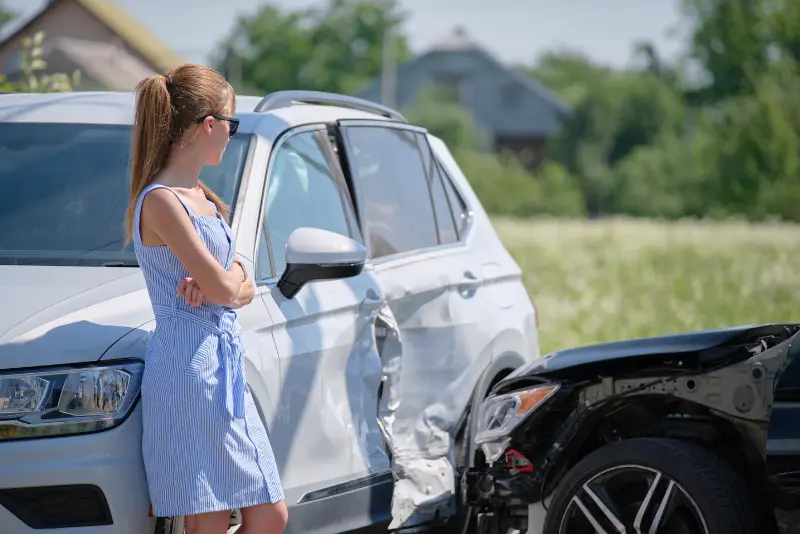
TL;DR: This blog will tell you how California splits fault in a pileup, how comparative negligence affects what you recover, and what a free case review can tell you about your own crash.
You Got Hit From Three Sides. Now what?
You’re stopped in traffic on the 405. Brake lights flash ahead. You stop in time. Then a car slams into your trunk, another hits your side, and a third clips your front bumper.
Three impacts, three drivers, and nobody agreeing on what happened.
Who do you call first? The tow truck, your own insurer, or one of the three other drivers who are already blaming each other? A pileup isn’t a two-car fender bender where fault is obvious from the dented bumpers alone. Working out who hit whom, in what order, and why is the entire problem, and the answer decides who pays for your medical bills, your car, and your time off work. At Freeway Injury Lawyer, that sorting is the work we do every week for people who were driving normally one minute and standing on the shoulder of a freeway the next. Here’s how these cases actually come together, and what tends to go wrong when someone tries to handle one alone.
Fault in a Pileup Starts with the First Impact
Investigators look for the “first harmful event,” or the mistake that started the chain reaction. But the first impact does not always mean one driver is responsible for everything. Other drivers may also share blame if they were speeding, following too closely, distracted, or failed to react in time.
For example, one driver may brake suddenly, another may be too close to stop, and a third may fail to react because they were distracted. Understanding how these actions connect helps determine who was responsible for each impact. Freeway injury lawyers are here to prove fault in your multi-vehicle pileup accident.
Pileup claims can become difficult when drivers give conflicting accounts. Police reports provide a useful starting point, but they may not capture the full sequence of a complicated crash. Evidence such as vehicle damage, witness statements, photos, and video footage can help show what happened and prevent blame from being placed on the wrong driver.
How Does Comparative Negligence Work in California?
Even if you share some blame, you can still recover money. California follows “pure comparative negligence,” so a jury or an insurer splits fault by percentage, and you’re paid for the share that wasn’t yours, even if you were mostly responsible.
The rule comes from a 1975 California Supreme Court decision, Li v. Yellow Cab Co. of California, which threw out the old all-or-nothing standard as unfair. Before that ruling, a driver who was even slightly at fault could walk away with nothing, no matter how much the other side was to blame. The court decided that the outcome punished people out of proportion to what they’d actually done wrong.
In multi-vehicle collision accident cases, that percentage split gets contested car by car. The driver in the middle of the chain, for example, might get hit from behind and pushed into the car ahead, and insurers will sometimes try to pin partial fault on that middle driver for the second impact even though they had no control over it. Adjusters use the comparative negligence rule as a lever, assigning you a bigger share of blame than the evidence supports because every percentage point shifted onto you is a percentage point they don’t have to pay. An attorney can push that number back down with reconstruction evidence, medical records, and witness statements instead of letting an adjuster’s first offer stand as the final word.
Why Freeway Pileups Get So Complicated
Pileups aren’t just bigger crashes. Several insurers may get involved, police reports can conflict, and weather conditions can make it harder to determine what happened. In a two-car accident, there are usually two drivers and two insurers. In a five-car pileup, several drivers may blame each other, making fault much harder to sort out.
In January 2024, a pileup involving as many as 40 vehicles shut down Interstate 5 near the Grapevine after dense fog reduced visibility to about 10 feet. Investigators described three separate core collisions close together. Two people died, and nine were injured, according to NBC News.
The example shows why freeway pileups can be difficult to investigate. Weather, multiple impacts, and several drivers can all affect what happened. Proving fault often requires looking at the full crash sequence and road conditions, not just the damage to each vehicle.
How Is Fault Determined in a Chain-Reaction Crash?
Reconstruction is part science, part detective work. Investigators study:
- Skid marks and where each vehicle came to rest
- Dashcam and traffic camera footage
- 911 call timestamps
- Damage patterns that reveal impact order
- Statements from every driver and witness
The National Transportation Safety Board’s preliminary report on a 2025 “end of queue” crash on Interstate 75 shows how detailed this gets. Investigators mapped vehicle types, lane positions, and the sequence of each impact as a truck failed to slow for stopped traffic. Strong California claims are built the same way. Without that detail, insurers are left estimating, and their estimates rarely favor the injured driver.
What Affects the Value of a Multi-Car Claim?
There’s no flat number for a multi-car claim. The value depends on several factors, including:
- Medical bills — Your current and future medical treatment and related expenses.
- Lost wages — Income you lost because your injuries kept you from working.
- Pain and suffering — The physical pain and emotional impact caused by the crash.
- Severity of injuries — Serious or long-term injuries can have a greater effect on claim value.
- Property damage — Damage to your vehicle and other personal property may also be considered.
- Shared fault — Your compensation may be reduced if you are found partly responsible for the crash.
- Insurance coverage — Multiple drivers and policies may affect where compensation can come from.
Our team of lawyers looks at the full picture, including your injuries, financial losses, available insurance coverage, and evidence showing how the crash happened. Because every multi-car accident is different, your claim should be evaluated based on its own facts rather than a promised settlement amount. You can check the areas we serve for your own convenience.
What a Free Consultation Can Tell You
A free consultation can help you understand what your options are after a multi-car crash. You can learn what evidence may support your claim, which insurance policies may cover your injuries, who may be responsible, and what deadlines could apply to your case.
Our lawyers can review the crash, explain your legal options, and help identify important evidence before it is lost. We can also handle communications with multiple insurance adjusters so you do not have to manage several insurers on your own.
Frequently Asked Questions
What are my options if the crash wasn’t my fault?
“Not your fault” doesn’t mean the insurers will agree. Drivers blame each other constantly, and a consultation can tell you what evidence supports your version of events.
How long do I have to file a claim in California?
Generally, two years from the date of the crash. If a public entity like Caltrans or a city may share responsibility, a government claim is usually due within six months.
Will my case go to trial?
Most multi-vehicle cases settle before that point. Even so, a case that’s prepared as if it might go to trial tends to get a better offer, because the other side can tell the difference between a claim that’s ready to be filed in court and one that isn’t.
What should I do right after a multi-car crash?
Call 911 and get medical care, even if you feel fine at the scene, since some injuries don’t show symptoms right away. You aren’t required to give a recorded statement to another driver’s adjuster before you’ve had a chance to think it through.
What does a consultation cost?
Nothing. We handle these cases on a contingency-fee basis, so attorney’s fees are owed only if we recover compensation for you. Case costs and expenses are handled separately, and we put that in writing before you decide anything.
Key Takeaways
- California follows pure comparative negligence, so you may still recover compensation even if you share some fault for the crash.
- In a multi-vehicle pileup, identifying the first impact and full crash sequence can help determine who was responsible for each collision.
- Multiple drivers, insurance companies, weather conditions, and conflicting accounts can make freeway pileup claims more complicated than typical two-car crashes.
- The value of a multi-car claim can depend on medical bills, lost wages, injury severity, pain and suffering, property damage, shared fault, and available insurance coverage.
- A free case review can help you understand your legal options, the evidence that may support your claim, who may be responsible, and what deadlines could apply.
You Don’t Have to Sort Out the Insurers Alone
A multi-vehicle crash can leave you dealing with multiple drivers, insurance companies, medical concerns, and questions about who is responsible. You don’t have to sort through all of it alone. Our team can review the details of your crash, help identify who may be responsible, and explain your legal options.
From multi-vehicle collisions to other accident-related claims, our practice areas cover the different situations injured people may face after a crash. Every case is different, so understanding your options early can help you make informed decisions about what comes next.
Ready to discuss your case? Contact us for a free case review.